|
|
The Eclectic Physician
Medicinal Herb Monographs
Chamomile
Botanical Name
Matricaria chamomilla
|
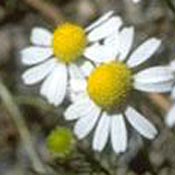
Matricaria chamomilla
(Chamomile) |
The information on this page compiled by
Beth Burch N.D.
Index
(click on the keywords)
Introduction
Chamomile has a long history of use as a gentle sedative and for easing
the discomfort of various gastrointestinal conditions. It is used both
in the botanical and homeopathic forms to treat teething symptoms in infants.
Its gentle action has made it a favorite remedy for children. Besides helping
to allay irritability, anxiety and sleeplessness, modern research has shown
that chamomile has antiinflammatory activity. The ability to decrease inflammation
along with easing intestinal spasms make it an excellent remedy for the
relief of conditions like irritable bowel syndrome. Topically, the antiinflammatory
activity is useful in skin conditions like eczema and can be tried for
any skin condition as an alternative to cortisone creams. Chamomile is
widely available in tea and liquid extract forms, as well as in a variety
of cream or ointment bases.
[ Back to the Index. ]
Description
-
Chamomile is a native of Europe and western Asia, and is naturalized and
cultivated throughout the world. A member of the Compositae family, chamomile
is an annual, growing up to 2 feet tall with branching stems. The leaves
are very fine and linear. It has a typical composite flower, with white
ray flowers and a yellow conical center that is hollow. The medicinal part
is the flowers. Another plant known as chamomile with similar actions and
uses is Anthemis nobilis. Also from the Compositae family, it is a perennial
with a daisy like flower- its yellow center is solid.
[ Back to the Index. ]
Constituents
-
Volatile oils including a-bisabolol, bisabolol oxides, and matricine (converts
to chamazulene with steam distillation)
-
Flavonoids including apegenin and quercitin
-
Hydroxycoumarines
-
Mucilages
[ Back to the Index. ]
Action/Effects
-
Intestinal antispasmodic (5)
-
Mild sedative/anxiolytic (1)
-
Antiinflammatory (2)
-
Carminative (reduces flatulence)
-
Antibacterial
[ Back to the Index. ]
Conditions used
for
-
Inflammatory skin conditions like eczema (4)
-
Wounds (3)
-
Irritability/Anxiety/Insomnia (especially in children)
(1)
-
Colic/Irritable bowel (5)
-
Indigestion
[ Back to the Index. ]
Dosage
-
Internal-
-
Tea- 2-3 teaspoons to 1 cup boiling water, steep and strain and drink up
to four times a day.
-
Liquid extract- 1- 1.5 teaspoons three times a day
-
Dry in capsules- 1000 mg three times a day
-
Best taken between meals.
-
Children’s dosage- Multiply adult dosage times the child’s weight, then
divide by 150.
-
External-
-
Cream or ointment- apply liberally to affected areas three times a day.
[ Back to the Index. ]
Side Effects
[ Back to the Index. ]
Contraindications
-
Allergy to plants of the compositae family, especially ragweed, aster or
mums.
[ Back to the Index. ]
Interactions
with medications
[ Back to the Index. ]
Use in
pregnancy & lactation
-
Safe for use in pregnancy and lactation
[ Back to the Index. ]
References
1. Viola H et al, Apigenin, a component of Matricaria recutita
flowers, is a central
benzodiazepine receptors-ligand with anxiolytic effects, Planta Med
1995;61(3):213-6
2. Safayhi H et al, Chamazulene: an antioxidant-type inhibitor of leukotriene
B4 formation, Planta Med 1994;60(5):410-3
3. Glowania HJ et al, Effect of chamomile on wound healing--a clinical
double-blind study, Z Hautkr 1987;62(17):1262, 1267-71
4. Aertgeerts P et al, Comparative testing of Kamillosan cream and
steroidal (0.25%
hydrocortisone, 0.75% fluocortin butyl ester) and non-steroidal (5%
bufexamac) dermatologic agents in maintenance therapy of eczematous
diseases, Z Hautkr 1985;60(3):270-7
5. Achterrath-Tuckerman U, et al, Pharmacological investigations with
compounds of chamomile V. Investigations on the spasmolytic effect of compounds
of chamomile and Kamillosan on iolate guinea pig ileum, Planta Med 1980;39:38-50
[ Back to the Index. ]
* The information presented in this web site is intended to inform and educate.
It is not intended replace a qualified medical practitioner to diagnose or treat medical conditions.
|
|